Practical AI. Measurable results.

By John Harrobin - President/Senior EVP, Kinetic
Artificial intelligence may be the most overused phrase in business today.
At Kinetic, we’re taking a simpler, more demanding view: AI matters only when it improves outcomes for customers and employees. Does it help us build fiber faster? Keep customers connected? Make every interaction more useful? Eliminate work that adds cost but not value?
Our early results are clear. AI is already helping Kinetic accelerate fiber construction, prevent and shorten outages, reduce unnecessary dispatches, strengthen customer retention, and turn enormous volumes of operating data into faster, better decisions. This is not innovation theater. It’s practical technology, applied with operator discipline, against the issues that matter most.
AI helps us build and sell fiber
Kinetic is aggressively expanding fiber across our 18-state footprint at a scale unseen in company history, and every moment matters for communities waiting for a better internet experience. What would have taken months for engineers, planners, and operators is being completed in a fraction of the time.
Our internally developed Construction Optimization Engine evaluates dozens of variables - including available projects, permits, predecessor work, crew capacity, specialized skills, travel requirements, and local constraints - to match the right crews with the right jobs at the right time. The result is a prioritized construction plan designed to maximize households passed. Early use has increased our monthly construction throughput by 20%. This means more people and more communities get to experience fiber sooner.
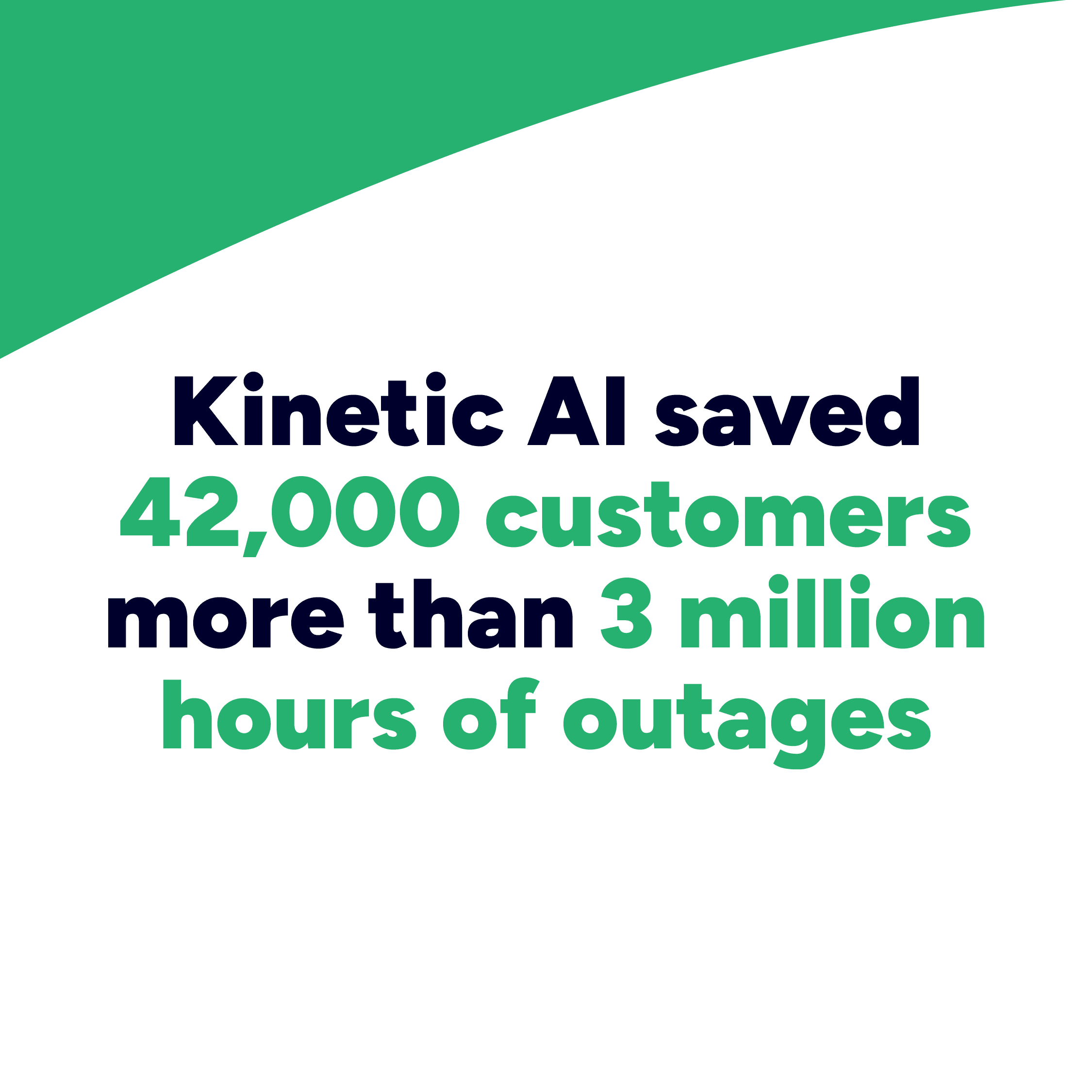
We’re applying the same mindset to network reliability. Through significant investment, Kinetic has built smarter systems to detect problems faster, understand which customers are affected, and direct our teams toward the true root cause. In 2026 alone, these capabilities prevented approximately 3 million hours of outages for more than 42,000 customers who would have otherwise been affected. The most powerful part of that result is what customers did not experience: interrupted work calls, frozen videos, missed school assignments, or lost connections with family and friends.
A critical capability is our common-cause framework. A single fault in shared equipment can create a storm of alarms across dozens of homes and businesses, which historically, could generate multiple trouble tickets, separate investigations, and unnecessary truck rolls. Our system now connects network telemetry, light levels, error rates, service events, network topology, and customer context, then collapses those scattered symptoms into one actionable incident.
Powering this framework is an AI-based decision layer that helps determine the right response - common-cause repair, remote gateway remediation, targeted Wi-Fi outreach, or priority handling for customers with the greatest exposure. Across the targeted base, these programs have reduced avoidable dispatches by at least 10%.
Just as important, we’re practicing cost discipline when it comes to where we use the most advanced AI capabilities. Our Network Operations Center (NOC) receives roughly 41,000 alarms annually. Traditional automation already correlates about 80%. We’re not replacing effective automation simply because newer technology is available. Instead, we’re directing frontier large language models toward the approximately 8,000 complex cases that remain, where deeper reasoning can reduce mean time to recovery and pressure on our operations teams. That’s what an AI-first strategy should look like: use the right tool for each job and invest where the return is real.
AI helps us increase customer loyalty
The same principle is transforming how we serve customers. Our new, internally developed, AI-first platform, Voxiti, reviews customer conversations at a scale no human team could ever approach: approximately 405,000 calls, 4.5 million minutes of audio, and 345 million words each month. Voxiti processes more than 1,300 transcripts an hour. A single person would need more than 71 years to review one month of our calls.
In retention, AI guides customer treatment options, ensures best-offer compliance, and prevents unnecessary disconnects when customers move. In sales, it identifies the conversations and approaches that help reps recommend the right solutions and work more productivity. In repair, it surfaces signals that a poor experience may create a flight risk and enables corrective action. Across care, retention, and financial services, AI evaluates our adherence to our call-handling standards.
Those insights flow into agent coaching, retraining, daily compliance reporting, and root causes analyses. This feedback loop is helping us learn from every interaction, scale more quickly, and improve our operating leverage.
AI helps us improve efficiency
We’re putting advanced analytics directly into the hands of our people as well. Our internal analytics AI bot nicknamed Snowman can ingest data from Snowflake, Tableau and PowerBI dashboards, spreadsheets, presentations, PDFs, emails, call center transcripts, and other common formats; translate natural language questions into complex SQL queries and run them; apply documented business definitions; and conduct statistical analysis in Python or Excel.
Deep dives that once took weeks can now be completed in minutes. That does not replace human judgment. It gives our experts more time and more complete information to exercise it.
The next wave is already taking shape: Digital engineering tools have already helped us reduce the fiber deployment cycle time (from design to “open for sale”) by 25 days and we expect more improvement as these tools gather more data over time. We’re also deploying automated pre-survey capabilities that use GIS and other data to identify aerial versus buried drops before installation, helping us parallel path work and schedule efficiently.
Our award-winning Virtual Quality Assistant, TechMate, is being enhanced to grade splice-quality, equipment placement, neatness, and light-levels in real time, with the goal of reducing "not done" installations caused by construction issues. The next evolution of our NOC will use network and customer-specific signals to identify low light, gateway resets, and port problems before they become visible service failures.
At Kinetic, our priorities are straightforward: build fiber, sell fiber, increase customer loyalty, and improve efficiency. AI is becoming a force multiplier across all four. It helps us move faster without lowering standards, scale expertise without losing human connection, and prevent problems rather than simply responding to them.
A 20% increase in construction throughput, reduced cycle times, millions of outage hours avoided, fewer dispatches and richer insight from every customer conversation are meaningful accomplishments. But these are also just the beginning.
The companies that win with AI will not be those that talk about it most. They will be those that embed it into daily operations, measure its impact, and keep improving.
That is the path Kinetic is on, and we’re moving with increasing velocity.